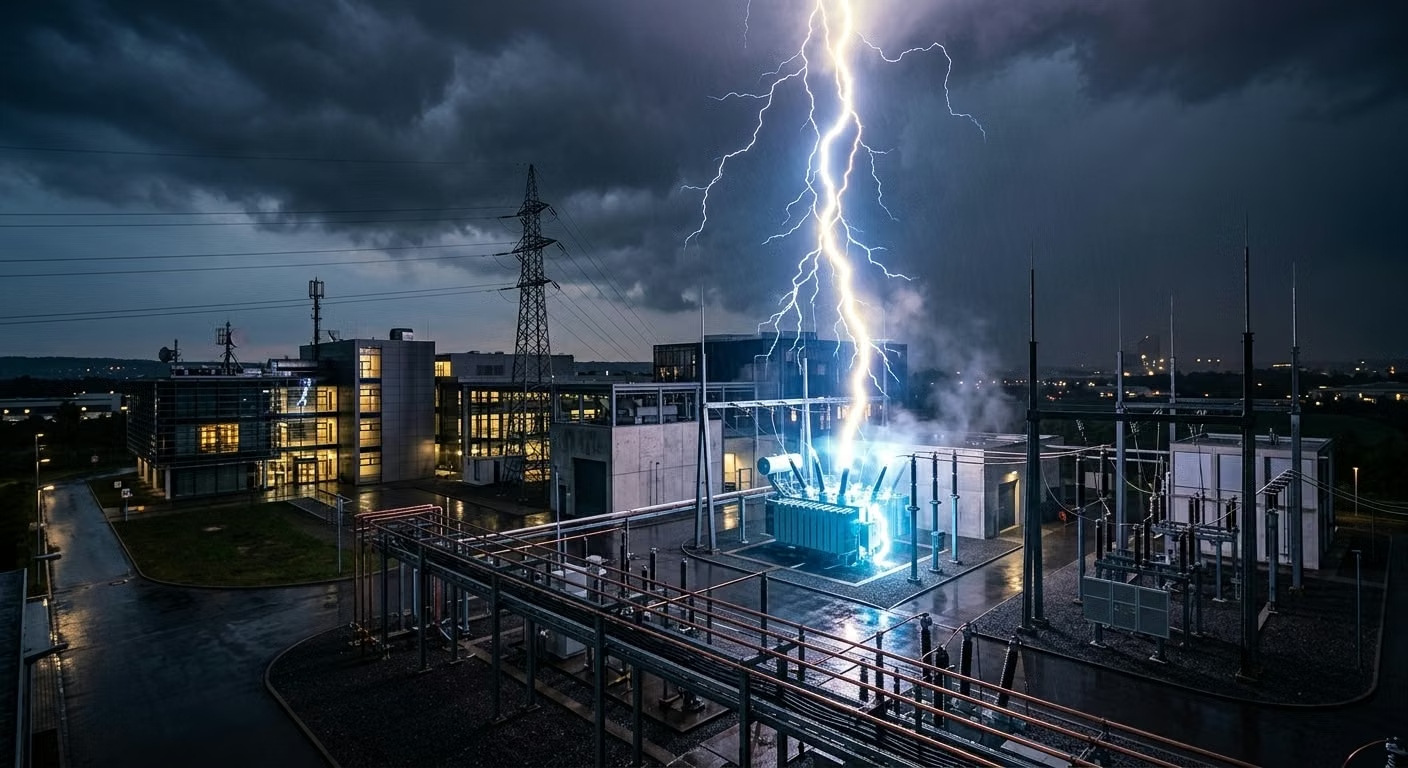
Every year, an average of 16 to 17 million storms occur on Earth, 44,000 per day. These are feared and desired in equal measure and bring with them rain, wind, lightning flashes, thunder, and lightning strikes. A complete visual and auditory spectacle.
Lightning is one of nature's most impressive phenomena, and we are very fortunate to be able to observe it from anywhere and at any time of the year.
Around 100 lightning strikes hit the Earth every second, but how are they formed?
The discharge of lightning occurs between clouds and the Earth's surface, or between two clouds. The light that accompanies the strike is known as a lightning flash. The sound produced by the shock wave of the electrical discharge is known as thunder. The first essential factor for a lightning strike to occur is to have a storm cloud, known as a cumulonimbus.
Lightning is produced by the interaction between positive and negative particles, but how does a storm cell become electrified?
Above 5 km, hail particles acquire a positive charge by colliding with ice crystals, which have a negative charge. Below 5000 meters, the opposite occurs.
The ice crystals, which are lighter than hail, are pushed towards the top of the cumulonimbus. These crystals form a positively charged zone between 8 and 10 km in altitude, while the negative charge accumulates at 5 km. In this way, a positive pole is left in the upper area and a negative pole in the lower area.
As a consequence of this, an electrical potential difference is generated both inside and outside the cloud, as the ground becomes positively charged, and the electrical discharge occurs. These are called negative lightning strikes, but there is also a type of lightning that carries a positive charge between the cloud and the ground, although they account for only 10% of the total.
The energy released by a lightning strike is not much, but since it occurs in thousandths of a second, its power is quite remarkable.