Information storage is becoming more important every day, but where do companies like Google, Amazon, or Apple, among others, store this information? They keep it in data centers, which are enormous buildings with servers containing critical information for thousands of companies worldwide. This gives rise to the need to protect these physical servers against lightning strikes or electrical surges, and that is the topic of this post. Due to this large increase in the production of electronic data, companies store their data in data centers. These data centers are built with elements that are sensitive to heat and electrical fluctuations. Methods to ensure high levels of speed, uptime, and data handling capacity are intertwined in data centers through:
- Generating a power supply system with redundant generators to ensure the servers are always on.
- HVAC systems to prevent fires and server failures.
- Grounding and surge protection systems to ensure there is no loss of vital data.
Data loss in data centers can occur due to:
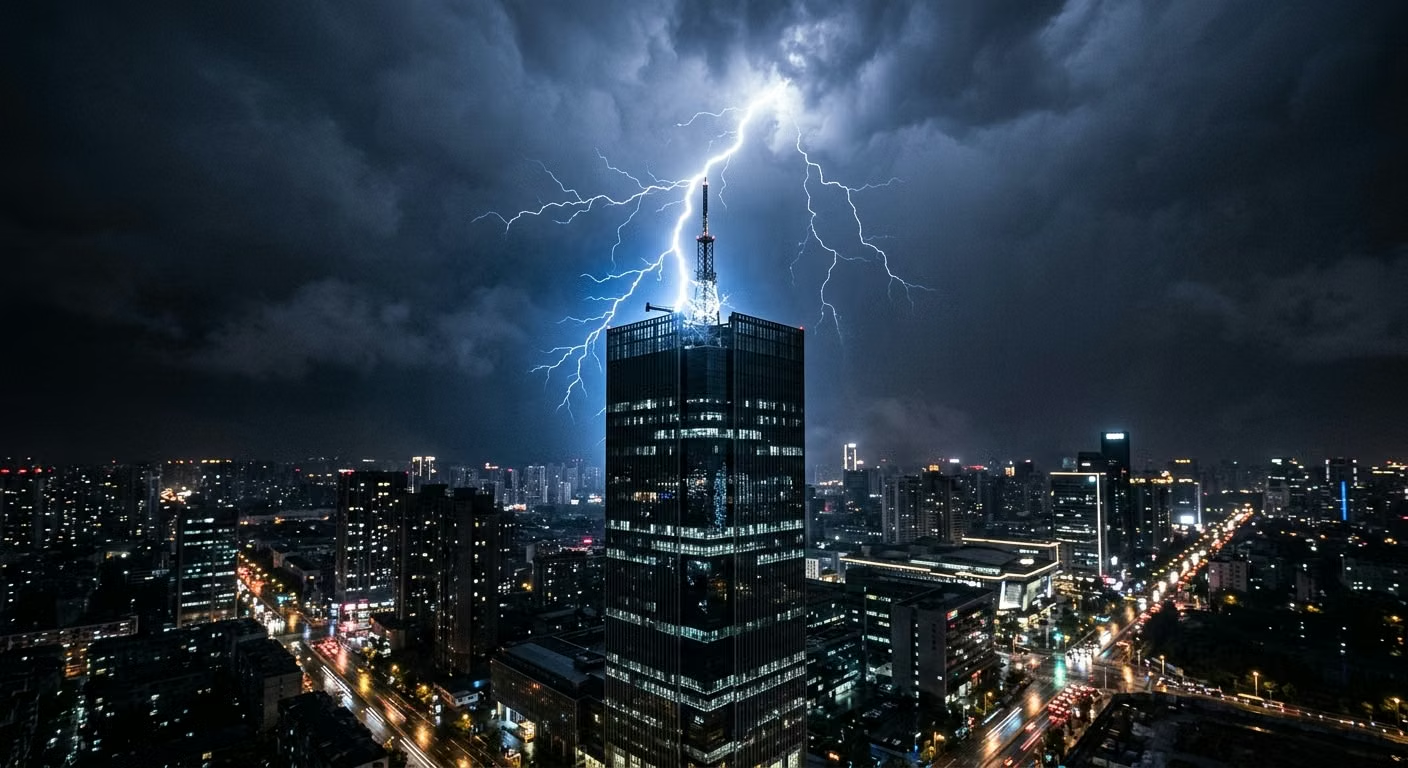
- Surges due to direct or indirect lightning strikes
- Power outages and fluctuations
- The potential difference between different grounding components
PROTECTION MEASURES FOR DATA CENTERS
PDC (Early Streamer Emission lightning rod)
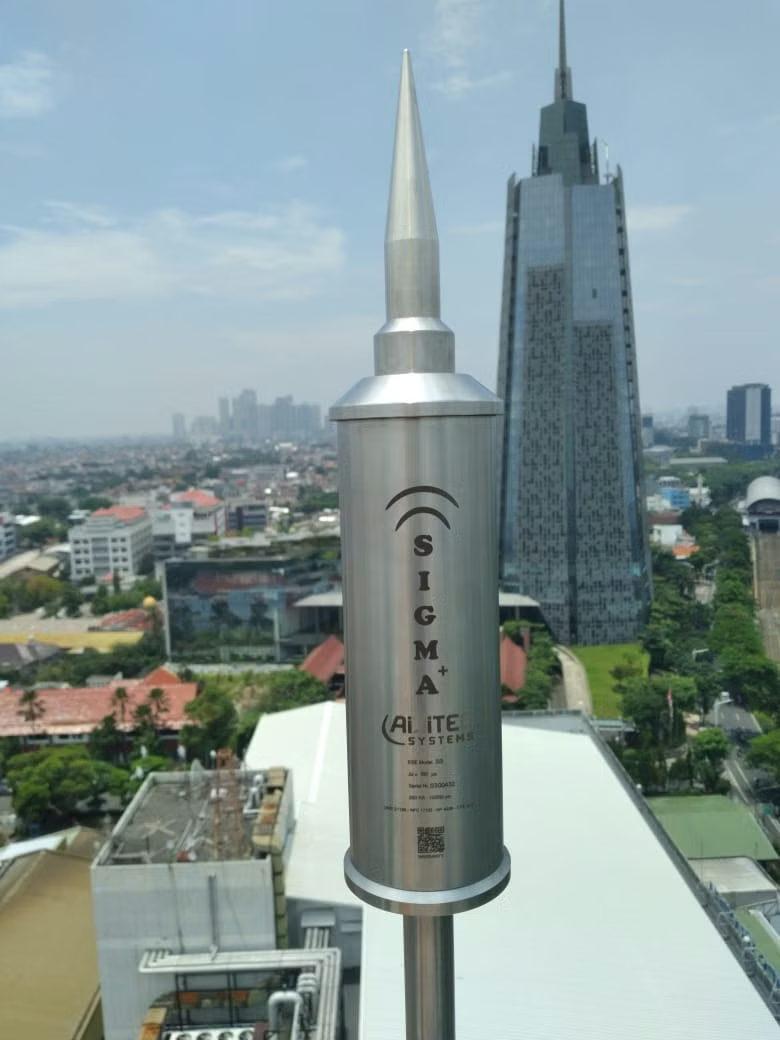
Installation of a PDC Early Streamer Emission lightning rod Nothing can stop the formation of lightning during a storm, but installing a PDC ADVANCE+ ensures an optimal level of protection, offering maximum safety to people and electrical installations.
PDC ADVANCE+ are the perfect solution for protection against lightning, being capable, through proper installation, of safely conducting all the lightning's energy to the ground. In addition, all our lightning rods have a limited lifetime warranty against all manufacturing defects. The PDC ADVANCE+ is the best protection with the latest technologies incorporated and the greatest guarantee of operation. This device has successfully passed tests based on the UNE 21186, NFC 17102, and NP 4426 standards for early streamer emission lightning rods:
- SALT SPRAY AND SULFUROUS HUMID ATMOSPHERE
- CURRENT TESTS (200kA – 10/350 µs)
- EARLY STREAMER EMISSION TIME
As a result of the research and R&D projects carried out, the ADVANCE+ lightning rod incorporates the following new technologies:
- EAC – EARLY STREAMER EMISSION STABILIZATION The dual energy block allows for a maximum deviation of 5% in the early streamer emission time based on the product certification regulation.
- DSF – FORCED BLOW DEIONIZATION Allows for the deionization of the ionization vault by the Venturi Effect, releasing a large amount of hot air at the moment of a lightning strike, expelling the soot caused by the deflagration.
- AAA – WATER INSULATION ASSURANCE Allows the PDC electrodes to be kept insulated, maintaining their potential difference at all times in conditions of extreme rain by electron displacement. Having a dual energy block ensures the main system is charged.
- AAE- ELECTRIC ARC ELONGATION Prevents the deposition of highly conductive soot on the PDC electrodes, maintaining their potential difference and preventing the self-discharge of the energy block.
LIGHTNING STRIKE COUNTER
It is a measuring device that does not interfere with the operation of the protection system but is undoubtedly recommended for all installations, as it is the only way to know that the system has suffered a strike and to know that we are protected. The ADT Counter counts and records direct strikes and surges of a lightning protection system. Due to its design and materials, it is robust, reliable, and autonomous. It does not require an external power supply and is compatible with any lightning rod.
The ADT Counter lightning strike counter must be installed on the most direct down conductor to the ground. The most common location is on the down conductor with the least ohmic resistance or, alternatively, the straightest or shortest one.
INSTALL SURGE PROTECTORS
SPU (Unified Protection Systems) equipment is specially designed for the protection of DATA CENTERS. SPU protection equipment is characterized by:
- Three or four protection stages, depending on the model, coordinated to guarantee the protection of the DATA CENTER.
- Protection threshold against transient surges very close to the nominal voltage of the installation.
- 10 independent protection modes; L/L, L/G, L/N, N/G.
- High discharge capacity; Up to 4,500kA (8/20us)
- High response speed to transients.
By installing an SPU on the main busbar or electrical panel of the DATA CENTER we will be protecting all the lines connected to it against surges (L/L, L/G, L/N, N/G) and MF/HF harmonics (RFI Filtering). These protection systems are capable of dissipating a large amount of energy, and will eliminate any type of transient surge (atmospheric discharges, maneuvers in the electrical grids, motor startups and shutdowns, voltage oscillations, voltage spikes originating inside the facilities, inductions when lightning strikes the lightning rod, etc...) and spikes associated with micro-outages coming from outside the facilities generated by switching in power distribution lines. Likewise, they will also filter medium and high-frequency harmonics (RFI Filter) generated by non-linear loads, such as variable speed drives, UPS, switched-mode power supplies, etc. Thus, by installing this equipment, we will prevent electrical failures in electronic cards, power supplies, UPS, electronic equipment, etc., in short, we will eliminate all failures whose cause is transient surges and medium and high-frequency harmonics. Most commonly proposed equipment: SP 4D-100
The model to be installed will depend on the nominal voltage, type of electrical network, and power of the DATA CENTER.
- SPU SERIES INSTALLATION MODE
- SPU PARALLEL INSTALLATION MODE
GROUNDING OF DATA CENTER ELECTRICAL PANELS
Generally, data centers have conventional grounding systems for all their equipment. But it is recommended to ground the data center racks and cabinets separately. This can help minimize the effects of voltage surges and related damage. The data center cabinets and racks can be connected using jumpers, nut and bolt connections with paint-piercing washers, etc. to make electrically continuous bonds and connect them to the ground. The grounding of the data center can be easily understood at different levels, starting with the first level, including the cabinets and racks that are bonded together, the second level, which includes the various equipment including servers, power systems, HVAC control systems, other hardware, etc. Then come the signal reference grids or floor ground, then there is the containment ground which consists of each component being connected to the equipotential bonding bars. Soil Resistivity Soil resistivity is always the main factor considered when designing and testing the grounding system of any facility. It is the basis of the electrical grounding system design and it is important to eliminate any errors from the soil resistivity tests. The final soil resistivity of data centers should be less than 1 ohm. Ground enhancers like WELCONDUCTOR are used to reach optimal values, preferably with a spark gap.
For all these reasons, it is essential to be protected; the lightning rod, grounding, and SPU equipment installations are fundamental for the operation of the data center. If you are working on a data center project, contact us to help you with the design of the lightning and surge protection.