Storms and lightning are fascinating weather phenomena, but it's necessary to be prepared, as they have a high mortality and accident rate. In light of this, the most important thing is to be very well informed. Therefore, below we share some myths and realities related to this phenomenon.
"If it's not raining over our heads, we are safe from a lightning strike."
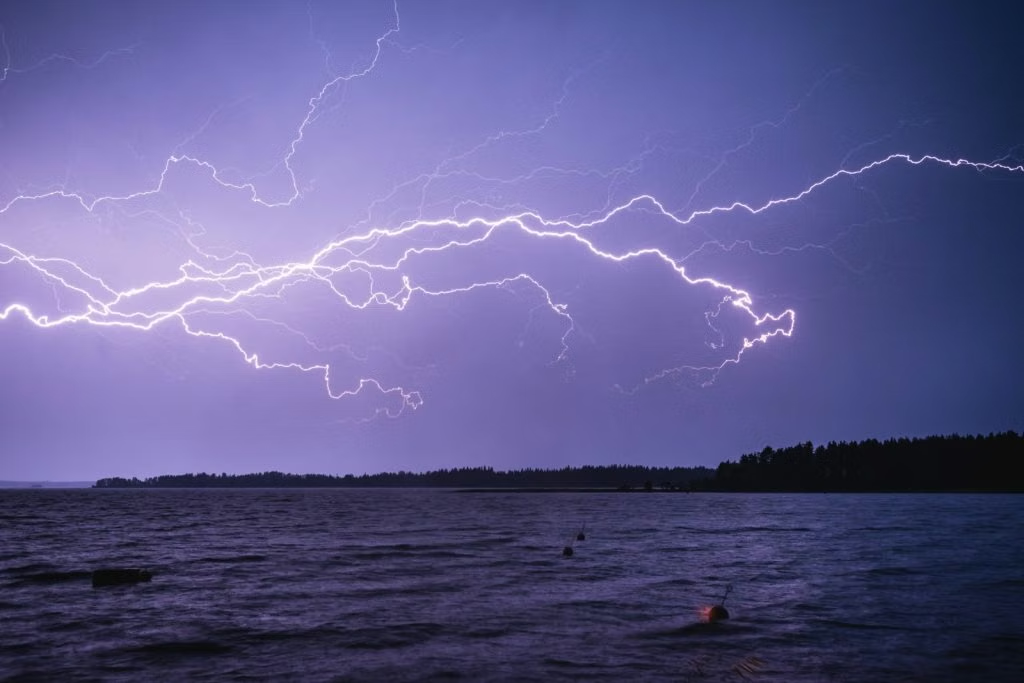
Many of us believe that cloud-to-ground lightning is vertical. But, according to worldwide research, these bolts can travel horizontally for 10, 15, 20km and even more, leading to a lightning strike without a prior storm, under a clear sky.
"Lightning never strikes the same place twice."
Lightning very frequently strikes the same place. This is because it "looks for" high, isolated, or pointed places. For this reason, skyscrapers and large structures, like the Empire State Building or the Eiffel Tower, receive nearly 100 strikes per year.
"Car tires protect us from a lightning strike."
It is very difficult for lightning to strike a vehicle due to its rounded shapes and lack of protrusions. But, if this were to happen, it would be the car body that would protect us from this impact. This is because the metal acts as a Faraday Cage and conducts the lightning around the exterior of the vehicle to the ground. The same thing happens with airplanes.
"Metal structures and objects attract lightning."
Lightning usually strikes high, isolated, or pointed areas. But, the material or the presence of metal does not determine the point of impact. However, metal does conduct electricity. Therefore, it is advisable to stay away from fences, train tracks, etc.
"Inside a house, we are safe from electrical discharges."
Even if we are inside our home, every precaution should be taken. Therefore, it is very important to avoid certain actions during a storm, such as washing dishes, using a landline phone and computer, or watching television. This is because pipes and electrical wires are excellent conductors. Therefore, if lightning strikes and you are in contact with any of these devices, the discharge can reach you.
"If you are in an open field and are caught in a storm, you should lie on the ground or take shelter under a tree."
The first and most important thing to do is to find safe shelter, avoiding taking cover under a tree. Trees are usually tall and pointed, and they also stand out from the rest of the vegetation. For this reason, taking shelter under a tree is one of the main causes of death by lightning strike.
Secondly, lying down increases the probability of a lightning strike hitting us, as the current travels through the ground. Therefore, the best way to act, if there is no nearby place to take shelter during the storm, is to squat with your feet together and your head tucked between your legs. Cover your ears and eyes and wait for the storm to pass.
"We shouldn't touch a person struck by lightning because they remain electrified."
When lightning strikes a person, the electrical charge does not remain in their body. In fact, we should immediately attend to someone injured by lightning while we wait for medical assistance to arrive.